Time Well Spent
Edward Ruscha:The Poetry of the Everyday
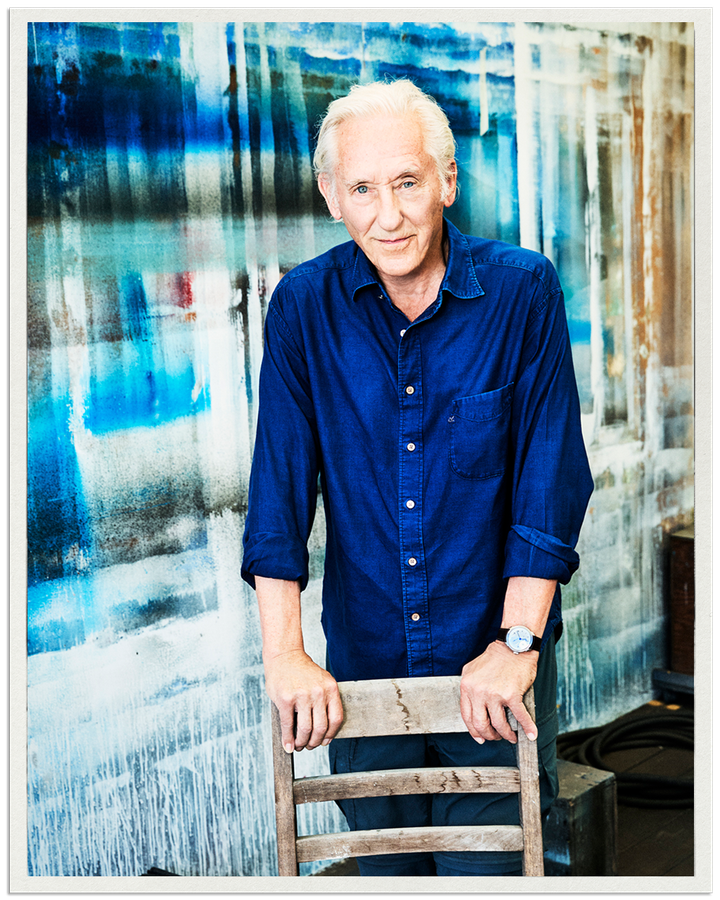
One of the most important living painters, Ed Ruscha, has spent his career building a distinct and groundbreaking visual language.
Time Well Spent
One of the most important living painters, Ed Ruscha, has spent his career building a distinct and groundbreaking visual language.
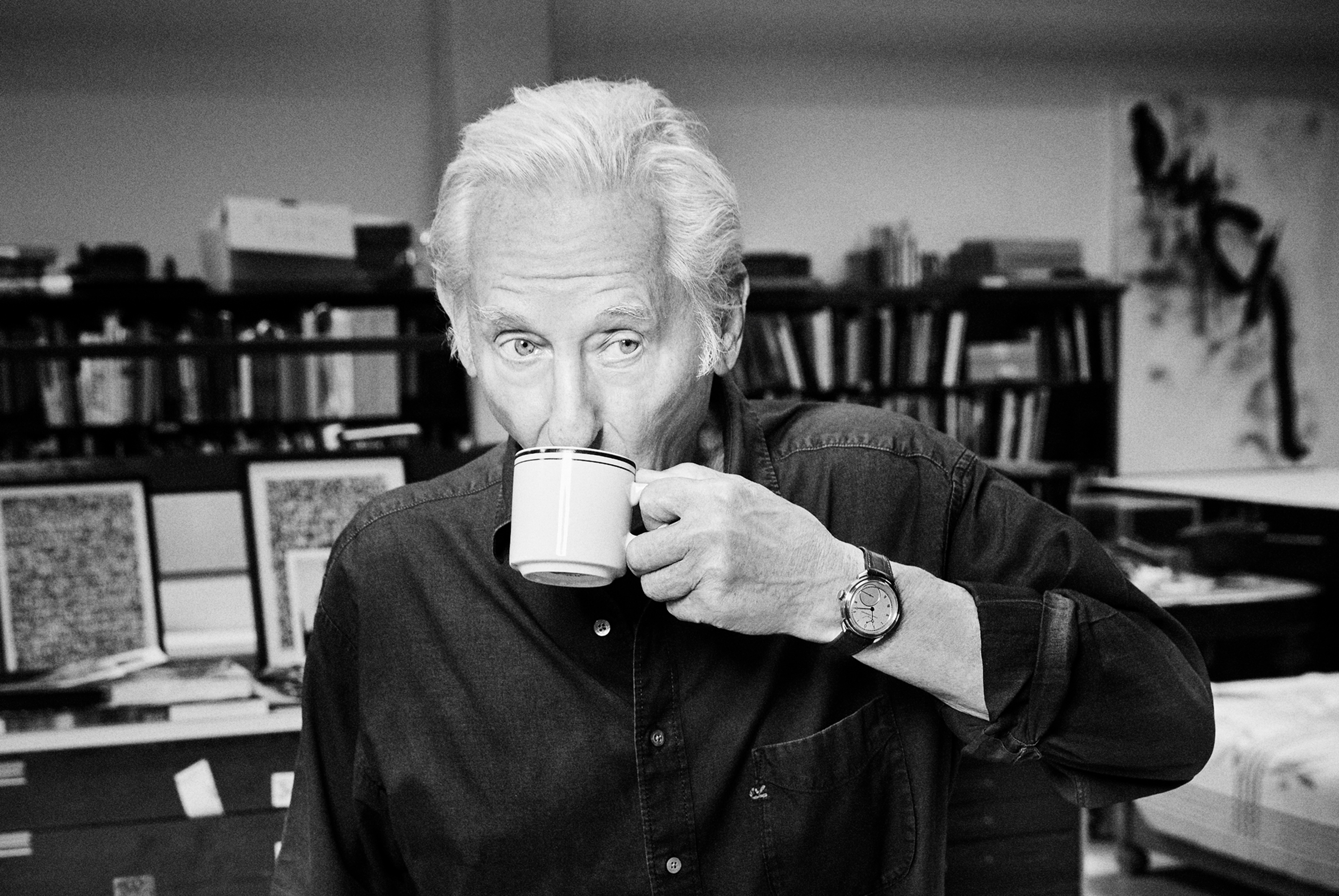
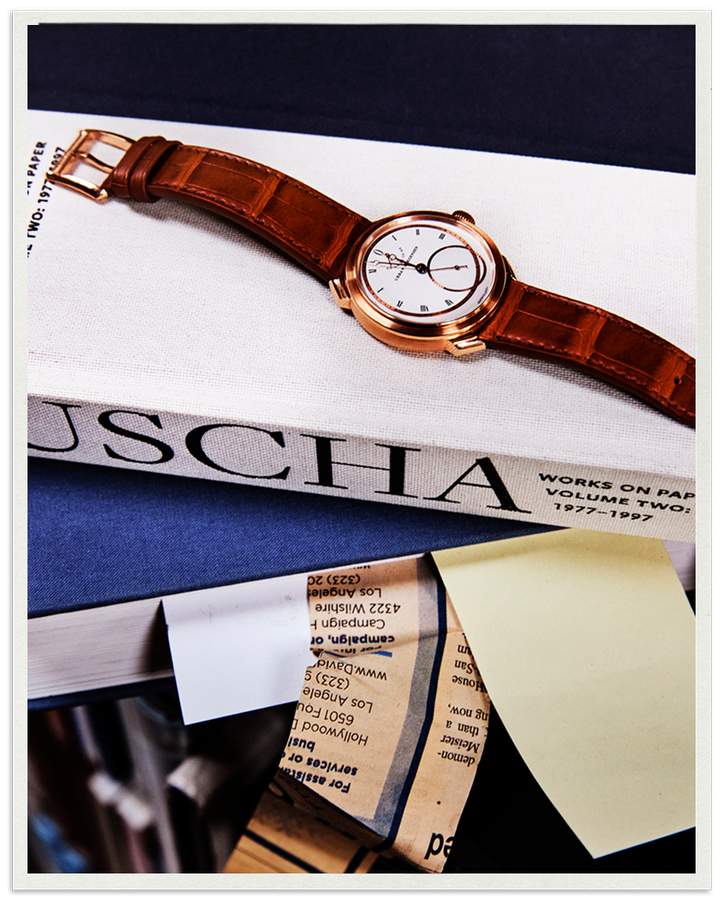
In this chapter of Time Well Spent – our series celebrating those who spend time as beautifully as they keep it – we look to Ed Ruscha the revered Los Angeles based artist who transformed everyday phrases, gas stations, and commercial logos into expressions of modern life.
Born in Omaha and raised in Oklahoma City, Ruscha grew up under the gaze of the Bible Belt, but was pulled by the energy of rock and roll and his unwavering aspiration of being an artist to California. He always nurtured a romantic view of Los Angeles shaped by an early childhood visit; New York was too cold, too high pressure, but Los Angeles, with its palm trees, sprawling, sun-soaked cityscape, and Californian lifestyle felt like possibility – despite having practically no art scene at the time. What began as infatuation, became a lifelong love affair.
Ruscha attended art school at Chouinard Art Institute, now Cal Arts, in 1956, initially intending to become a commercial artist. The competitive camaraderie between his classmates pushed him toward great experimentation, yet Ruscha had no interest in the dominant tide of Abstract Expressionism. Rather, he sought the opposite – capturing the real. A single image in Print Magazine, Jasper Johns’ collage painting “Target with Four Faces” burst open his perspective. Art, he realized, could be premeditated, reflective of life, yet still emotional and alive.
This spirit led Ruscha to language itself as a subject. Having always enjoyed setting type, he was drawn to the aesthetics and emotional impact that words could have. One of the first was “Boss,” a word that could point to an employer, an expression of coolness, and a brand. He found that the interpretations, and coinciding feelings, multiplied endlessly. Soon, onomatopoeic words, like “Honk,” “Smash,” and “Oof,” found their way into Ruscha’s universe. In his hands, the words became the subject, the mystery, and the resolution – a universally human statement.
In 1962, Ruscha participated in the first show later associated with the Pop Art movement, curated by Walter Hopps at Pasadena Art Museum. His three works were shown alongside Roy Lichtenstein, Andy Warhol, and Jim Dine, marking a shift to representational subjects in American art. Hopps simultaneously ran Ferus Gallery, a nucleus of like-minded emerging artists. Ruscha never fell neatly into this fraternized circle, with his unclassifiable works spanning inspiration from Dada, Pop, Conceptualism, and beyond. Reflectively, he sees his inspiration as ever-flowing and multi-directional.
Los Angeles was slowly blooming as a hub for contemporary artists beginning with Ferus – and the world was taking notice. At Ferus, where exhibitions opened every Monday, Ruscha’s first solo show opened in 1963. Dennis Hopper bought the first painting Ruscha ever sold.
The decades that followed brought bowling balls, syrupy words, logos, and pill bottles, all made from unexpected materials: grass stains, chocolate, gunpowder, and aspirin, to name a few. Play and experimentation remained essential. His everyday life became a source of inspiration. The Hollywood sign became a recurring subject born from his weather-telling routine—if he couldn’t see the sign from his house, it was too smoggy out. In the same spirit, the series Twentysix Gasoline Stations documented the gas stations from his recurring trip from Oklahoma City to Los Angeles.
Photography became another playground. His collections, The Streets of Los Angeles, a chronicle of fifty years of Los Angeles infrastructure, and Every Building on Sunset Boulevard, a faithful study of the evolution of Sunset Boulevard, marked a profound interest in the passage of time in his city. These photographic series, of which there were many more, became books and exhibits, but also meditations on the quiet drama, humor, and beauty hidden in the everyday.
Across six decades, Ruscha’s practice has stretched mediums and moods, but the thread remains the same: a deep curiosity about how we see, read, and move through this world. Looking, and truly noticing the mundane, is both discipline and delight. Ed Ruscha’s 2023-2024 retrospective at MoMA and LACMA, ED RUSCHA / NOW THEN, captures the astonishing continuity and evolution of Ruscha’s winding career and the way his work holds a mirror to American life.
For Ruscha, time well spent is not about chasing the spectacular; it's about sourcing the spectacular in the everyday. Pursuing the small sparks of intrigue and gleefully following wherever they lead. A gas station. A word. The 20th Century Fox logo. An art museum on fire. A phrase that makes you smile for no particular reason. Noticing, and capturing, is time well spent.
January 5, 2026
By Edward Ruscha